
Feeding and Eating Disorders
Table of Contents
Clinical Picture
Feeding and Eating disorders are complex mental diseases that affect a person’s mental and physical health involving emotion and behavioral disorder related to food (National institute of mental health, 2018). It’s a disorder which is related to severe disturbance in eating behavior. According to DSM-5 Feeding and Eating disorders are characterized by a persistent disturbance of eating or eating-related behavior that results in the altered consumption or absorption of food. Feeding and Eating disorders can significantly impair physical health or psychosocial functioning.
It is a condition whereby an individual either consumes a significantly high, low or binge amount of food that he/she requires for normal consumption. It’s also a condition where individuals consume nonnutritive, nonfood substances which are considered inappropriate for development.
This Feeding and Eating disorders is a culturally controversial disorder; it’s still not appropriated in some African and South Asian countries. Feeding and Eating are about more than weight—stress, trauma, loss of control, and participation in certain sports can all contribute to eating disorders, However Feeding and Eating can be treated.
The spectrum of Feeding and Eating disorders comprises Pica, anorexia nervosa (AN), bulimia nervosa (BN) and binge eating (BED), rumination disorders, avoidant/restrictive food intake disorder and otherwise specified and unspecified Feeding and Eating disorder. Eating disorders can affect people of all ages, racial/ethnic backgrounds, body weights, and genders.
Types of Eating and Feading Disorder
Anorexia Nervosa
People with anorexia nervosa significantly consume very little quantities of food or even leave it unfinished. They avoid food and severely restrict their food consumption and even practice exercise and binge purge (vomiting after eating). They fear gaining weight, and repeatedly weigh and mirror themselves. Some individuals also practice to vomit after consuming food, or use some laxatives, diuretics or other medical medicine to loosen their food. Even if they look underweight, they have a persistent feeling that they are gaining weight. Their selection of food portions are against the average calories required for their bodily development.
Bulimia Nervosa
People with bulimia nervosa have recurrent episodes of eating unusually large amounts of food and feeling a lack of control over these episodes. In simple terms individuals generally eat larger portions of food (binge eating), where individuals are often worried about their behavior and attempt to prevent weight gain by fasting, excessive exercise, self induced vomiting and use of laxatives, diuretics (Czyzyk, 2015). People with bulimia nervously may maintain normal weight but most of them are overweight.
Binge Eating
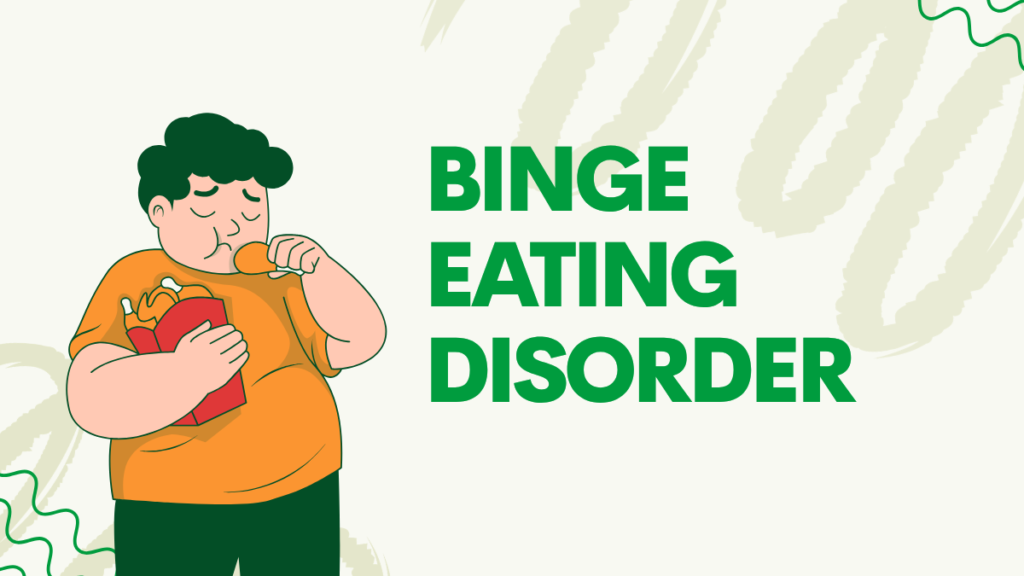
Binge Eating is another type of eating disorder is that individuals usually consume larger amounts of food than usual in a very short period of time. They often feel out of control and feel intense shame and guilt afterwards. People with binge eating disorder do not loosen either via vomiting, exercise or medicine. They seem to be extremely overweight. The difference between bulimia and binge eating disorder is the practice of binge eating after consuming food, whereas in BED individuals don’t practice binge eating.
Comorbidity
Feeding and Eating disorders are comorbid with drug use disorder (and vice versa) (Nokleby, 2017). Depressive symptoms are likely to have frequency with BN, AN & BED. There may also be an increased frequency of anxiety symptoms or anxiety disorders itself. Drug abuse (stimulants) is also linked with BN. Whereas AN is associated with OCD, alcohol use and substance use disorder. Binge eating disorder is also comorbid with the same disorders as AN & BN but, lesser degree to substance use disorders (APA, 2013).
Epidemology
The development of deeding and eating disorders including AN, BN & BED affects many young women and even men in the productive period of their lives (Rikani, Choudhry, Ikram, 2014). AN is relatively common among young women as their desire to have an ideal body image, risk-group is 15-19 year old girls. (Simink, Hoek, Hoeken, 2012). About 1 in 200 female youth develop anorexia nervosa. BN is common among young male i.e. 19- 20 years (Fankhauser, n.d). Although eating disorders often appear during the teen years or young adulthood, they may also develop during childhood or later in life (40 years and older).
For lifetime prevalence rates of eating disorders, 1 % develop AN, 1 to 4.2% develops BN and 0.7 to 4% have BED. About 50% of individuals with AN will later develop bulimic symptoms and 35% of individuals with BN have history of AN. Rates of eating disorders are higher below 20 years of age (Fanlhauser, n.d). Binge eating disorder is more common among males and older individuals. Eating disorders are a serious disorder in the USA.
Etiology
The causes of Feeding and Eating disorders are multifactorial and include biological, social cultural factors and psychological factors.
Like most psychological disorder, eating disorder run in families and have a genetic component (Trace, Baker, Bulik & Penas-Lledo, 2013). Genetic predispositions have found that ration of 4.9 for the presence of disorder in first degree relatives (Fanlhauser, n.d). In a Bulimia twin study by Kendler et.al, 1991 and anorexia twin study by Walters and Kendler, 1995 23% identical twin have bulimia compare to 9% of non identical twin (Barlow, 2015).
One popular neurochemical candidate cause for EDs is serotonin (Brewerton 1995), serotonin imbalance has more surface appeal than most other biological hypotheses of ED. Low level of serotonergic activity in serotonin associated with eating disorder (Russell, 2009). Other major neurotransmitter system includes Norepinephrine and Dopamine (Barlow, 2015).
Athletes, actor or actress, model, gymnastics, wrestler are susceptible to eating disorder, as we expect them to be attractive and assertive. Media often distort the reality and portray models or celebrities for having naturally thin body. So it is not unusual for individuals to lose their weight. Similarly mistreatment, disapproval for affiliation, discrimination among peers can also lead the individuals to have anorexia (Levine et.al 1994). However eating disorder don’t occur uniformly in all cultures at the times, in many cultural have good shape and size of body is consider to be individuals form wealthily family and vice versa.
Psychological factors can also contribute to eating disorders; low self esteem may contribute to eating disorder (Fairburn et.al. 197). Peers rejection of being either anorexia or bulimia can lower self esteem and maladaptive behavior of eating, the individuals may either over eat or under ate. Girls with low self-esteem are more likely to develop disordered eating in the next few years (Button et al. 1996). Being perfectionism obsession though can cause AN and lesser extent to BN (Garner et.al.1993). Depression in other hand can also cause eating disorder.
Treatment
If left untreated, Feeding and Eating disorders can result serious health crisis. feeding and eating disorders can be treated with blend of availability of non pharmacy and pharmacy treatment. If condition is less severe psychological base treatment is preeminent, while if the situations is worse and sever psychiatric treatment is most. The aims of treatment are to restore patients to healthy diet, change their belief.
Nutritional rehabilitation counseling program helps to individuals who are diagnosis with AN, BN, BED to restore their normal health weight and to normalize their eating patterns by asking them to develop structure meal plan. Psychosocial intervention helps patient to understand and changes the behavior and dysfunctional attitudes related to eating disorder. Psychosocial intervention can take places either CBT, IPT (Watson & Bulik, 2013). CBT is favor treatment, in which individual learns how to change abnormal thought and behavioral. If CBT fails IPT is prefer. Family therapy is also considered in adolescents who live with their parents (Treassure, 2015). Self help group and 12 step recovery programs for eating disorders helps in decrease relapse.
References
- Nokleby, H. (2017). Comorbid drug use disorders and eating disorders — a review of prevalence studies. Sage journal doi.org/10.2478/v10199-012-0024-9. 29 (3).
- Rikani, A., Choudhry, Z., Choudhry, A.M., & Ikram, H., (2014). A critique of the literature on etiology of eating disorders. Annals of Neurosciences DOI: 10.5214/ans.0972.7531.200409 20(4).
- Smink, F.R.E., Hoeken, D.V. & Hoek, H.W (2012). Epidemiology of Eating Disorders: Incidence, Prevalence and Mortality Rates. Current Psychiatry Reports. DOI: 10.1007/s11920-012-0282-y. 14(4)
- Fankhauser, M.P. (n.d) Eating disorders.
- Trace, S.E., Baker, J.H., Penas-Lledo, E., & Bulik, C.M. (2013). The genetics of eating disorder. Anuual Review of Clinical Psycholgy, 9
- Barlow, D.H., Allen, L.N., & Basden, S. (2007). Psychological treatment for panic disorder, phobias and generalized anxiety disorders. 3rd Edition . Oxford University Press.
- Brewerton, T.D. (1995). Review: toward a unified theory of serotonin dysregulation in eating and related disorders. Psychoneuroendocrinology. 20.
- Russell, G. (2009). Disorders of eating: anorexia nervosa in Barlow, D.H.,Abnormal psychology intregated approach (Eds). Cengage learning.
- Levine, M.P., Smolak, L., Moodey, A.F., Shuman, M.D. & Hessen. L.D. (1994). Normative developmental challenges and dieting and eating disturbances in middle school girls. Int. J. Eat. Disord. 15
- Fairburn, C.G., Welch, S.L., Doll, H.A., Davies, B.A. & O’Connor, M.E. (1997). Risk factors for bulimia nervosa—a community-based case-control study. Arch. Gen. Psychiatry 54
- Button, E.J., Sonugabarke. E.J.S., Davies, J. & Thompson, M. (1996). A prospective study of self-esteem in the prediction of eating problems in adolescent schoolgirls: questionnaire findings. Br. J. Clin. Psychol. 35
- Garner, D.M., Olmsted, M.P. & Polivy, J. (1983). Development and validation of a multidimensional eating disorder inventory for anorexia nervosa and bulimia. Int. J. Eat. Disord. 2:
- Watson, H.J., & Bulik, C.M. (2013) Update on the treatment of anorexia nervosa: review of clinical trials, practice guidelines and emerging interventions, Psychol.
- Med. 43
- J. Treasure. (2005). Treatment of anorexia nervosa in adults, Psychiatry 4