












Cognitives Biases & Errors in Problem Solving
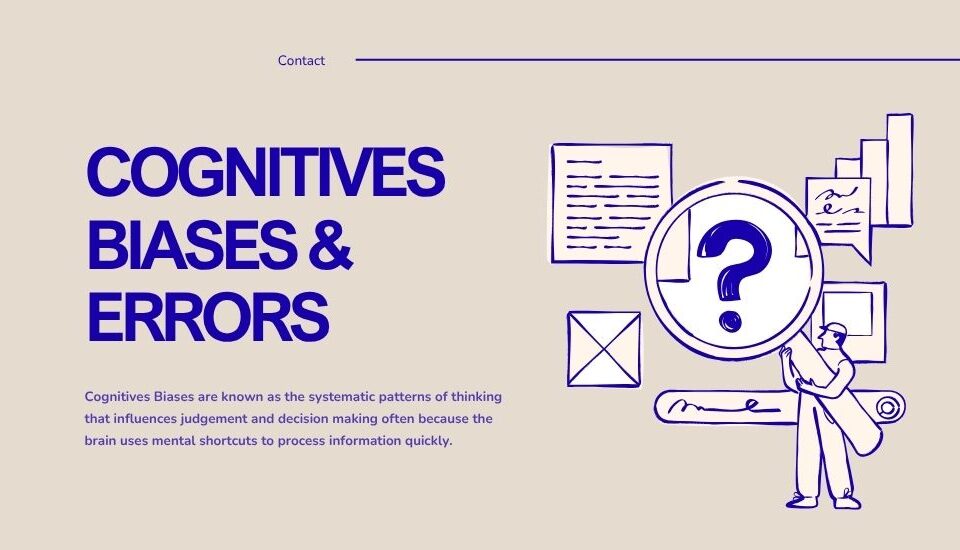
Cognitives Biases are known as the systematic patterns of thinking that influences judgement and decision making often because the brain uses mental shortcuts to process information quickly.Cognitives Biases are subjective in nature, how a particular individual thinks doesn’t have to be the same as other individuals.Cognitives Biases generally destroy how we interpret the information that our sense organ receives. It also affects our judgement regarding certain stimulus, stimulus here can be anything that our sense organs receive.
Table of Contents
Cognitives Biases generally lead to poor decisions, it undermines objective problem solving. For example if we believe a particular phone brand as the best brand among all brands that is available, we tend to notice its positive features rather than negative, we also ignore all its disadvantages that are available.
Types
There are thoughtful list of Cognitives Biases available they are as discussed below
Confirmation Bias
Confirmation Bias is one type of Cognitives Biases, where individuals have a tendency to look for, interpret and remember information that supports their existing belief while they completely ignore information that contradicts them. It generally reduces objective thinking, and makes them ignore alternative explanations due to which they lead to incorrect conclusions.
We see what confirms what we already believe
For example, students studying bachelor level education believe online learning is very ineffective, they focus on technical problems and distractions that happen during digital learning while they completely ignore the example of students who have thrived during online learning.
Representativeness Bias
Another form of Cognitives Biases is representativeness bias. In this type of bias individuals judge a person, situation or event by how closely it resembles their mental image or stereotype of a category. Representativeness bias can produce inaccurate judgement as it makes individuals overlook actual evidence. It is because of stereotypes.
If it looks like the category, we assume it belong to it
For example, if a person is quiet, enjoys reading and prefers working alone, we assume that they are probably a librarian not a salesperson. As a salesperson I would be more extroverted and love to talk rather than read. This is because the salesperson personality fits it in our stereotype.
Availability Bias
Availability bias is another type of Cognitives Biases judging the likelihood of an event based on how easily examples come to mind, not on actual probability. Recent or emotional info gets too much weight and we assume to judge the event based on our experience.
What comes easily to mind feels more common.
For example, individuals have seen several reports time and again regarding plane crashes. A person who may believe that flying is extremely dangerous because they may remember the news that reported the accidents, it may not resemble actual statistical risk.
Hindsight Bias
Hindsight bias is the psychological tendency of individuals to believe that after an event has occurred, that it was predicted or expected to happen, even if it was totally unpredictable beforehand.The effect of problem solving is that it creates an unrealistic view of past decisions. It prevents accurate learning from mistakes. Hindsight Bias makes outcomes seem more predictable than they were.
After it happens, it seems obvious.
For example, a company launched a new product. After the products are sold on markets it totally fails. An employee says, i knew from the start that this would fail, though they hadn’t predicted it before.
Overconfidence Bias
It’s those types of Cognitives Biases where individuals have greater confidence in their own knowledge, abilities, skills and decisions. They justified it with the evidence. These types of individuals make people less likely to seek advice from others. They make decisions or solve problems spontaneously which may lead to risky decisions as they reduce their preparation time.
Confidence doesn’t always mean competence.
For example, a student who is attaining their university exam may believe that one night of study would be enough for preparation. They are confident in their ability and skip the early study. In the end they perform poorly and confidence outpaces their preparation.
Anchoring Bias
In Anchoring Bias individuals relay heavily on the first piece of information when making a decision. The first information they had received became a mental reference point and it made it very difficult to adjust their judgement.
The first number can pull individuals judgement toward it
For example, an individual who goes to a fancy store to buy a jacket, the shopkeeper offers the price and says the jacket costs rs 10,000, later offers it for rs 6,000. Even at a real jacket buying price was 4000 and in this case 10000 still pulls judgement.
Escalation of commitment
An individual with escalation of commitment, continues to invest their time, money, effort despite their initial investment failing. They continue their investment in failing projects and believe that they have already invested and focus on past investment over future outcomes. They prevent accepting mistakes and changing course.
Past investment should not determine future decisions.
For example, a person invest 5 lakhs in a new business, the business keep losing money, they add addition 3 lakh and more and says that i’ve already invested so much on it, i am not giving up despite being failed on that business
Comparision
| Bias / Error | Main Problem | Simple Example |
| Confirmation Bias | Seeking supporting evidence | Only reading opinions that agree with us |
| Representativeness | Judging by similarity / stereotype | Assuming a quiet person is a librarian |
| Availability Bias | Relying on easily recalled examples | Thinking plane crashes are very common |
| Hindsight Bias | Believing an outcome was predictable | “I knew it would happen.” |
| Overconfidence | Overestimating one’s ability | Studying one night, trusting confidence alone |
| Anchoring Bias | Relying heavily on first information | First price influencing our judgment |
| Escalation of Commitment | Continuing a failing decision | Investing more in a losing business |
Strategy
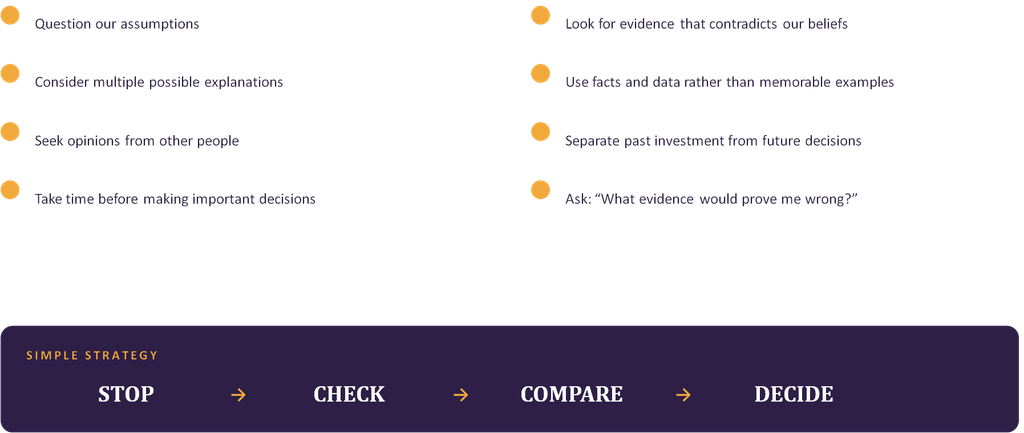
How can you reduce these Cognitives Biases?
Conclusion
Problem solving is not always completely rational. Cognitive biases shape how we perceive information, evaluate alternatives, and make decisions.