



























Skip to content
-
Subscribe to our newsletter & never miss our best posts. Subscribe Now!
MIND TALK

Psychology, Research & Education

MIND TALK

Psychology, Research & Education

  • Psychopathology
    • Anxiety Disorder
      • Generalized Anxiety Disorder
      • Obsessive Compulsive Disorder (OCD)
      • Panic Disorder and Agoraphobia
      • Post-Traumatic Stress Disorder
      • Phobia
        • Social Anxiety Disorder
        • Specific Phobia
    • Neurodevelopment Disorder
      • Attention Deficit Hyperactivity Disorder
      • Intellectual Disability
      • Specific Learning Disorder
      • Autism Spectrum Disorder
    • Feeding and Eating Disorder
      • Anorexia Nervosa
      • Bulimia Nervosa
      • Binge-Eating Disorder
    • Somatic Symptom and Related Disorders
      • Factitious Disorder
    • Bipolar and Related Disorder
    • Substance Related Disorder
    • Schizophrenia
  • Abnormal Behaviour
    • Definition of Abnormal Behaviour
    • History of Abnormal Psychology
    • Approaches to Abnormal Psychology
      • Biological Approach
        • Structure and Function of Neurons
        • Neurotransmitters and Glands
      • Psychoanalytic Approaches 
    • DSM-5-TR
  • Research Methodology
    • Sampling Design
    • Research Proposal
  • General Psychology
    • Introduction
    • Motivation and Emotion
    • Thinking and Problem Solving
  • About
Close

Search

  • https://www.facebook.com/
  • https://twitter.com/
  • https://t.me/
  • https://www.instagram.com/
  • https://youtube.com/
Reinforcement
Operant Conditioning
Manic and Hypomanic
Bipolar and Related Disorder
Sampling
Sampling Design, Probability and Non Probability
Cognitives Biases
Cognitives Biases & Errors in Problem Solving
Problem Solving
Problem Solving
Psychoanalytic Approaches
Psychoanalytic Approaches 
History of Psychology
Motivation and Motivation Cycle
Theories of Emotion
Theories of Emotion
Factitious Disorder
Factitious Disorder
Substance Related Disorder
Research Proposal
Research Proposal Format
Neurotransmitters Glands
Neurotransmitters and Glands
Structure and Function of Neurons
Autism Spectrum Disorder
Autism Spectrum Disorder (ASD)
Approaches to Abnormal Psychology
Specific Learning Disorder
Abnormal Behaviour
Definition of Abnormal Behaviour
DSM
DSM-5-TR
Abnormality
History of Abnormal Psychology
Intellectual Disability
Panic Disorder and Agoraphobia
Attention Deficit Hyperactivity Disorder
Attention Deficit Hyperactivity Disorder (ADHD)
Obsessive Compulsive Disorder
Obsessive Compulsive Disorder (OCD)
Schizophrenia Disorder
Schizophrenia: Symptoms, Causes, Types, and Treatment
Anorexia Nervosa
Anorexia Nervosa
Bulimia Nervosa
Bulimia Nervosa
Binge Eating
Binge-Eating Disorder
Anxiety Disorder
Anxiety Disorder
Feeding and Eating Disorders
Generalized Anxiety Disorder
Generalized Anxiety Disorder (GAD)
Posttraumatic Stress Disorder
Post-Traumatic Stress Disorder (PTSD)
Social Anxiety Disorder
Specific Phobia
Specific Phobia
History of Psychology

History of Psychology

Updated on August 31, 2026

The word Psychology was derived from two Greek word psyche, meaning soul or mind and logos mean study. Thus, during the early philosophical period, it was simply understood as the study of the soul. But the definition and scope have changed significantly over the time. In the early days psychological questions were studied mainly within philosophical. With the development of scientific methods, it gradually emerged as an independent scientific study Thus it is said that psychology has a short but long past history.

Ancient Period 

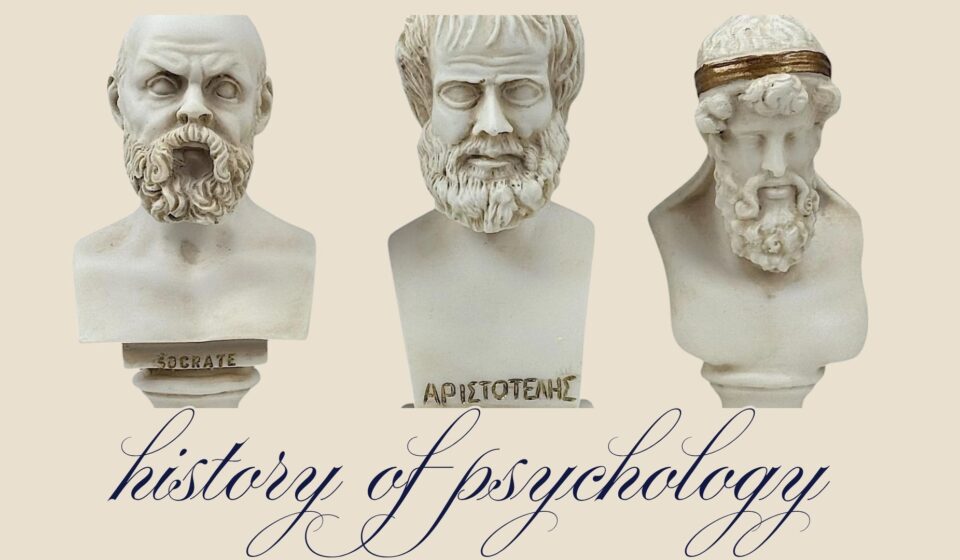
During the ancient period, Greek philosophers Socrates, Plato, and Aristotle made many contributions to psychology in ancient days. Their explanations were mainly philosophical and rational rather than systematic scientific investigation 

Socrates and Plato emphasized the importance of the soul in understanding human beings. They believe the soul was distinct from the physical body and continued to exist beyond physical death. Thus from their perspective the soul was an important subject for understanding human nature.

Aristotle on the other provided one the earliest systematic discussion of psychological issues in his work De Anima (On the soul) ). He discussed topics such as sensation, perception, memory and other. However, this ancient period faced Criticism which are mentioned below

  1. It was primarily philosophical based and they are rationalist, proposed theory isn’t scientific, 
  2. The existence and nature of  soul is doubtful, 
  3. They didn’t mention important concepts i.e consciousness and behaviour in their explanation. 

Pre Modern Period 

William Wundt and William James are known as key contributors to pre pre-premodern period. They are empiricists as their proposed theory was scientifically studied. William Wundt established the first psychological lab dedicated to experiimental psychology at the University of Leipzig Germany, in 1879, After that psychology became an independent branch. He defined psychology as science that studies conscious experience. He proposed the idea of Structuralism,(basic unit). Structuralism was the first school of psychology and focused on breaking down mental processes into the most basic components for e.g your experience at the ocean by saying it is windy, salty, and cold.

Whereas William James an American psychologist and philosopher developed the school of functionalism. Functionalism focused on the function and purpose of mental process and behaviour. It examined how mental activities help individuals to  fit into its environment. The early scientific approaches also faced several criticisms.

  1. Introspective was subjective and difficult to verify objectively. 
  2. It only focuses on conscious experience, not mentioning unconsciousness.  
  3. Didn’t mention overt behaviour. 

Modern Period (19 to 20 century)

The development of behaviorism brought another major change in psychology. BF Skinner, J.B Watson, Ivan Pavlov major contributor. They focused on observable behaviour. They said that psychology should study only overt behaviour meaning behaviour that can be directly observed and measured. Covert behaviour such as thoughts and subjective experience received much less attention. The main criticism they faced were they didn’t focus on non observable behaviour i.e covert behaviour.

Contemporay Psychology

The limitations of behaviourism contributed to the development of the cognitive revolution during the twentieth century. Psychologists increasingly began to study internal mental processes scientifically.

Today, psychology is understood as the scientific study of behaviour and mental processes. Contemporary psychology therefore includes both observable behaviour and internal psychological processes.

Thus, the history of psychology can be broadly understood as a gradual movement from the study of the soul, to the study of consciousness, then to the study of observable behaviour, and finally to the scientific study of both behaviour and mental processes.

Modern psychology studies areas such as:

  • perception
  • learning
  • memory
  • thinking
  • emotion
  • motivation
  • personality
  • social behaviour
  • development
  • biological processes
  • mental health

Therefore, although psychology has a relatively short history as an independent scientific discipline, it has a long past rooted in philosophy and the study of human nature.

Author

Anush Subedi

Follow Me
Other Articles
Previous

Motivation and Motivation Cycle

Psychoanalytic Approaches
Next

Psychoanalytic Approaches 

No Comment! Be the first one.

Leave a Reply Cancel reply

Your email address will not be published. Required fields are marked *

©Dolendra Nath Subedi, Kathmandu,Nepal. All rights reserved 2026

The information provided on MIND TALK is intended for educational and informational purposes only. It is not a substitute for professional psychological, psychiatric, medical, or emergency care. Readers should consult qualified professionals for individual assessment and treatment.