













Definition of Abnormal Behaviour
Table of Contents
Abnormal Behaviour
It’s very essential to know the disparity between normal and abnormal before getting into the subject matter of Abnormal Behaviour.
Literal meaning to abnormal is not normal, beyond normal or away from normal. It’s somewhat true but a definition of abnormal is vague, problematic and widely differentiated by person, time, place, culture, and situation. Explaining or applying it into the field of psychology is a multifarious task.
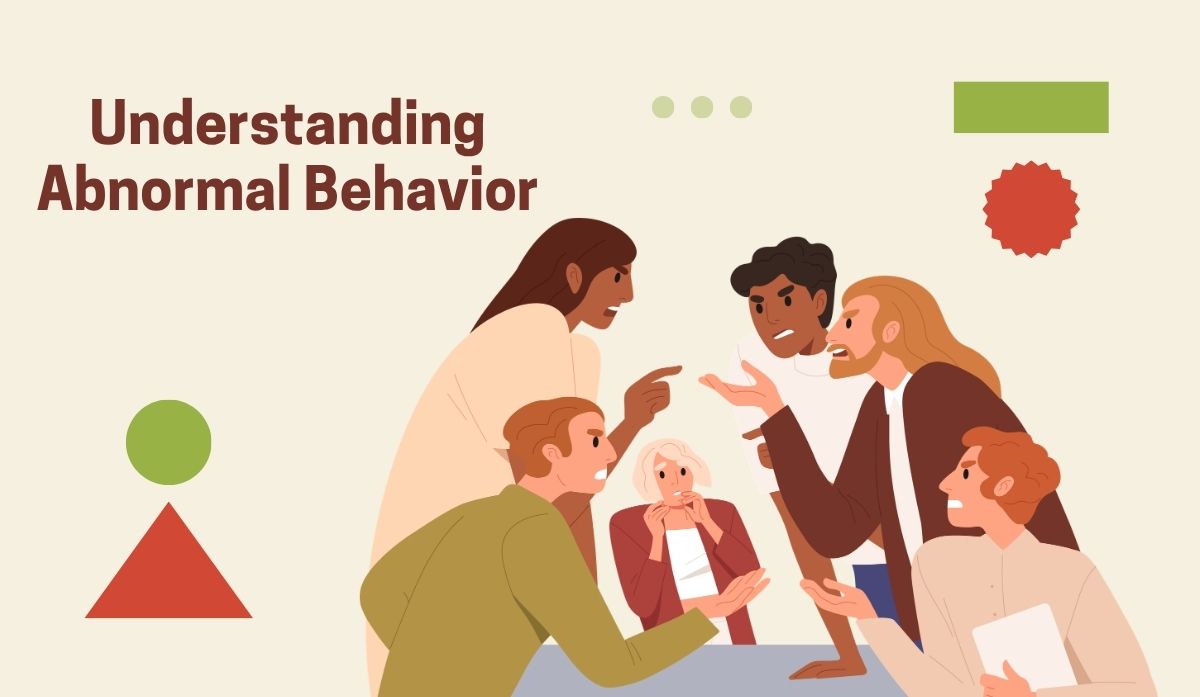
Normal however is much easier to explain than abnormal. Normal behaviors are the behavior that has approval of family members, societies, groups of people or even countries. Imagine that you are travelling in a bus, someone shouted at the driver for being too slow. How would you react to the person? You probably would consider it as a normal behavior upon certain situations and circumstances. Or imagine a person next to your table in a restaurant shouting at the waiter for delaying his/her order. You probably would react as normal. Thus, normal behavior refers to expected behavior in an individual significant to the situation.
Now imagine that your friend scored a good score on an IQ test, would you consider him abnormal? No you won’t, you would rather regard him for having higher intellectual abilities. For example , regarding restaurants in the above paragraph, let us now consider that person shouted at the waiter within 3 minutes of order, under such circumstances you would consider his behavior as abnormal or a person next to you on the bus is talking loudly on his mobile and is disturbing you and other passengers. Thus abnormal behavior refers to behavioral patterns that go against social expectations.
A behavior becomes normal or abnormal depending on the cultural context of the individual. A particular behavior that is considered as abnormal in one society may not be so in another. Defining Abnormal Behaviour depends upon by whom, where, when, why and how.
Abnormal behavior has multiple definitions. One of the widely accepted definitions developed by DSM-5 (the fifth edition) defines abnormal behavior as behavior that violates a norm in society, is maladaptive, is rare given the context of the culture and environment, and is causing the person distress in their daily life. The definition suggests that in order to categorize someone’s Abnormal Behaviour, behavior has to be unusual, not culturally accepted, and must result in distress or impairment in an individual.
Criteria for Abnormal Behaviour
Let discuss the criteria for determining Abnormal Behaviour, abnormal or abnormality.
- A behavior is unusual
- Behavior is socially unacceptable or violates social norms.
- The person is in significant personal distress.
- Behavior is maladaptive or self-defeating.
Behavior that is unusual
Imagine, an individual reports seeing or hearing things that are not really there, afraid of visualizing the image of a bird, walking in an elevator, unable to shop alone at a department store; such behavior is unusual in nature and often considered Abnormal Behaviour by our societies or culture. Seeing and hearing things is accepted in some religions or cultures. So, uncommon behavior is not abnormal. For example, athletes that set new records are often considered as unusual but their behavior is not considered as abnormal. Similarly perception or interpretation of reality is faulty and is also considered unusual.
Behavior is socially unacceptable or violates social norms.
A person in a city center is repeatedly murmuring and shouting ‘kill him’ ‘kill him’ or another person walking drunk in the daylight. Their behavior is not accepted by our societies and considered a violation of norms set by our societies. All societies have standard norms of rules and regulation, violating such standards is often termed abnormal. But if you are in a wrestling match, shouting “Kill him” is considered normal. Thus, the situation determines what is normal or Abnormal Behaviour.
The person is in significant personal distress.
The behavior must be associated with distress to be classified as Abnormal Behaviour. For example, an individual who has a traumatic experience of an earthquake may experience pain or emotional turmoil and may find themselves having to cope or imagine a daily life of depressed people. However if someone close to you died and you are in distress it’s usually considered as common. But if you are in distress for a longer period of time then it’s abnormal. It is normal to be in distress.
Behavior is maladaptive or self-defeating.
A maladaptive behavior that significantly has resulted in impairing his daily functioning of life is considered Abnormal Behaviour. Maladaptive refers to inability to function at an optimal or average level. For example, when a woman consumes psychoactive substances her cognitive and perceptual abilities are impaired and she would be at risk if she drives in this state. Similarly her behavior is self defeating behaviors which impairs health or social and occupational functioning may be viewed as abnormal. It’s also maladaptive because it impairs the individual’s ability to fulfill work and family responsibilities.
Drinking alcohol recklessly usually is self defeating behavior and consider atypical
Behavior is dangerous.
When an individual’s behavior is dangerous to themselves or a person living nearby such behavior is considered to be abnormal. A depressed person might kill himself or a person with schizophrenia may put oneself and/ or some other life at risk. To determine Abnormal Behaviour it doesn’t have to be killed to oneself or others, threatening physically, mentally is also called Abnormal behavior.
Thus abnormal behavior thus has multiple criteria. Depending on the situation, time and even a culture determine Abnormal Behaviour. When considering it some criteria may be weighted more heavily than others. But in most cases, Psychologists generally apply some combination of the above mentioned criteria in making a determination that behavior is abnormal.
Abnormal Psychology
With increase in literature and expertise in this field many psychologists working in the basic branch of psychology have defined abnormal psychology differently. There is hardly a single definition that would define abnormal in full term. But in short abnormal psychology is the branch of psychology that deals with the description, causes, and treatment of abnormal behavior patterns.
Abnormal psychology is the study of abnormal thoughts, feelings and behaviors. Abnormal psychology is the application of psychological science to understanding and treating mental disorders.
Abnormal psychology (also known as psychopathology) is a condition characterized by abnormal thoughts, feelings, and behaviors. Though the definition seems simple, to understand the word abnormal in abnormal psychology is a subject of debate and complex if you are immature in psychology.
Abnormal psychology studies abnormal behaviors; it examines the origins, manifestations, and treatments of disordered habits, thoughts, or drives.
Abnormal psychology is the branch of psychology that studies unusual patterns of behavior, emotion and thought, which may or may not be understood as precipitating a mental disorder. Although many behaviors could be considered as abnormal, this branch of psychology generally deals with behavior in a clinical context (Barlow, 2012).
Abnormal psychology is a branch of psychology that deals with psychopathology and abnormal behavior. The term covers a broad range of disorders, from depression to obsession-compulsion to sexual deviation. Counselors, clinical psychologists and psychotherapists often work directly in this field.
Case Study
Suhana (f) is a 32-year young social activist. She is married for 8 years with 1 nearly born child of 1 year. Her husband is an army officer. Before getting to married life she was working as a school teacher for 6 years. Her married life was steady and reliable. She wants to change her profession but finding it very difficult to adjust and to get a new profession. Things are not working her way. For the last 2 years she often complains of hearing a voice from strangers which warn her that she is having bad luck in her life with bad luck, and often is having a terrific accident.
She strongly believes that message is conveyed by the god. Often anxious, she was a lucky bracelet given by religious leaders to keep the evil spirits away. Her imaginary voice had rooted in her mind, soon after she started to avoid public vehicles or drive her own fearing that she would have an accident. Her life was significantly disturbed, and had problems in her occupational and family life.
How would you describe Sahana behavior? Is Sahana behavior abnormal? If yes, how?
