












Skip to content
-
Subscribe to our newsletter & never miss our best posts. Subscribe Now!
MIND TALK

Psychology, Research & Education

MIND TALK

Psychology, Research & Education

  • Psychopathology
    • Anxiety Disorder
      • Generalized Anxiety Disorder
      • Obsessive Compulsive Disorder (OCD)
      • Panic Disorder and Agoraphobia
      • Post-Traumatic Stress Disorder
      • Phobia
        • Social Anxiety Disorder
        • Specific Phobia
    • Neurodevelopment Disorder
      • Attention Deficit Hyperactivity Disorder
      • Intellectual Disability
      • Specific Learning Disorder
      • Autism Spectrum Disorder
    • Feeding and Eating Disorder
      • Anorexia Nervosa
      • Bulimia Nervosa
      • Binge-Eating Disorder
    • Somatic Symptom and Related Disorders
      • Factitious Disorder
    • Bipolar and Related Disorder
    • Substance Related Disorder
    • Schizophrenia
  • Abnormal Behaviour
    • Definition of Abnormal Behaviour
    • History of Abnormal Psychology
    • Approaches to Abnormal Psychology
      • Biological Approach
        • Structure and Function of Neurons
        • Neurotransmitters and Glands
      • Psychoanalytic Approaches 
    • DSM-5-TR
  • Research Methodology
    • Sampling Design
    • Research Proposal
  • General Psychology
    • Introduction
    • Motivation and Emotion
    • Thinking and Problem Solving
  • About
Close

Search

  • https://www.facebook.com/
  • https://twitter.com/
  • https://t.me/
  • https://www.instagram.com/
  • https://youtube.com/
Reinforcement
Operant Conditioning
Manic and Hypomanic
Bipolar and Related Disorder
Sampling
Sampling Design, Probability and Non Probability
Cognitives Biases
Cognitives Biases & Errors in Problem Solving
Problem Solving
Problem Solving
Psychoanalytic Approaches
Psychoanalytic Approaches 
History of Psychology
Motivation and Motivation Cycle
Theories of Emotion
Theories of Emotion
Factitious Disorder
Factitious Disorder
Substance Related Disorder
Research Proposal
Research Proposal Format
Neurotransmitters Glands
Neurotransmitters and Glands
Structure and Function of Neurons
Autism Spectrum Disorder
Autism Spectrum Disorder (ASD)
Approaches to Abnormal Psychology
Specific Learning Disorder
Abnormal Behaviour
Definition of Abnormal Behaviour
DSM
DSM-5-TR
Abnormality
History of Abnormal Psychology
Intellectual Disability
Panic Disorder and Agoraphobia
Attention Deficit Hyperactivity Disorder
Attention Deficit Hyperactivity Disorder (ADHD)
Obsessive Compulsive Disorder
Obsessive Compulsive Disorder (OCD)
Schizophrenia Disorder
Schizophrenia: Symptoms, Causes, Types, and Treatment
Anorexia Nervosa
Anorexia Nervosa
Bulimia Nervosa
Bulimia Nervosa
Binge Eating
Binge-Eating Disorder
Anxiety Disorder
Anxiety Disorder
Feeding and Eating Disorders
Generalized Anxiety Disorder
Generalized Anxiety Disorder (GAD)
Posttraumatic Stress Disorder
Post-Traumatic Stress Disorder (PTSD)
Social Anxiety Disorder
Specific Phobia
Specific Phobia
Reinforcement

Operant Conditioning

Operant conditioning is learning theory or a learning process which was studied by Edward Thorndkike but later expanded and made famous by B.F Skinner which emphasize on reinforcement and punishment. His main idea was behaviour can be strengthened or weakened by its consequences. This theory suggests that we are more or less likely to show our behaviour depending upon its consequences. Consequences of the behaviour are either reward or punish. We individuals repeatedly show behaviors if there are positive outcomes and avoid those leading to unpleasant ones. B.F Skinner believes that people learn not only from what they see, but also from what happens after their action.

Experiment

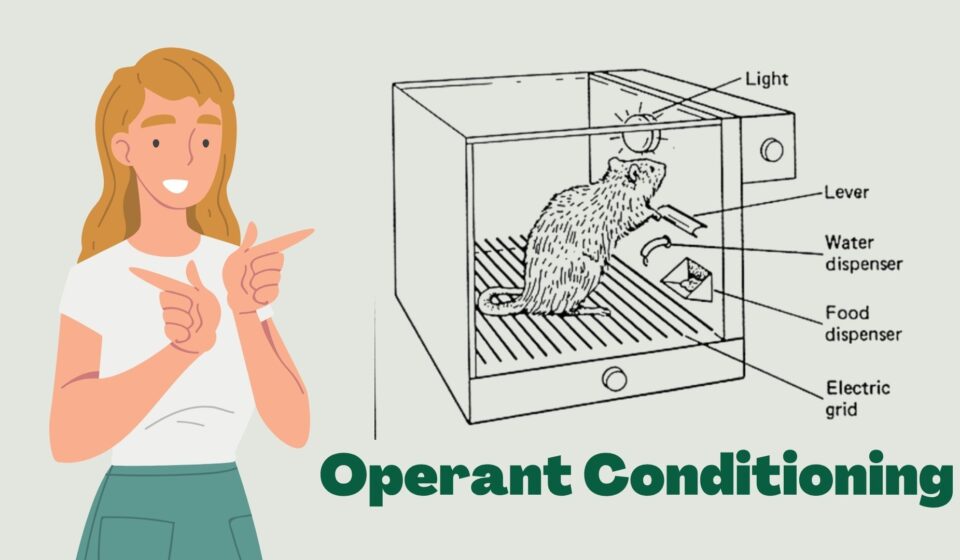
An operant conditioning experiment demonstrates how voluntary behavior can be strengthened or weakened through its consequence. The classical laboratory example is BF Skinner’s operatant condition experiment demonstrated by using a rat in a skinner box. A hungry rat was placed inside a chamber known as a skinner box. Inside a chamber there is a mechanism, there is a lever, pressing the lever will provide the food in the food palette.

A hungry rat was placed inside the skinner box, initially the rat explored the chamber, when the rat accidentally pressed the lever food pellet released food, the rat consumed it and continued to explore. Each time the rat presses the lever, food is provided. After repeated trials the rat begins pressing the lever more frequently. the increase in lever pressing demonstrate that the behaviour has been reinforced by food.
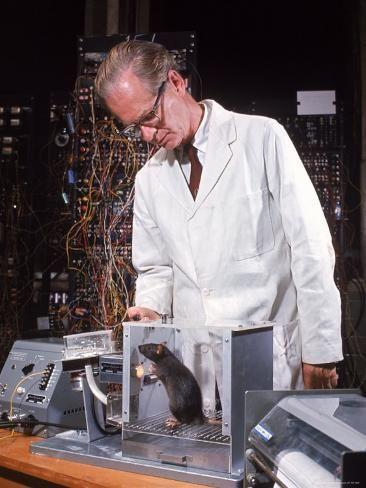
Table of Contents

  • Experiment
  • Positive and Negative Reinforcement
  • Positive and Negative Punishment
  • Limitation

There are mainly four quadrants concepts of operant conditioning which are explained below:

Positive and Negative Reinforcement

Positive reinforcement is that type of strategies where positive pleasant stimuli are added so that likelyhood of positive behaviour is likley to happen in future.For example, when students get good marks parents give them gifts or employees perform very well if the office manager gives them a bonus.This means positive consequences result in positive behavior. 

Negative reinforcement is that type of reward mechanism where unpleasant stimuli are removed. It does not mean punishment, here unpleasant stimuli are removed for showing the positive behaviour or resulting in the positive behaviour. For example: When students finish your assignment and score good marks, the teacher stops giving them an additional assignment. Similarly when employees submit their work on time, their manager stops giving them later hour work. In this example, unpleasant stimuli are removed for showing a positive outcome. 

Positive and Negative Punishment

Positive Punishment is that type of strategies where unpleasant stimuli are added to reduce the negative behavior. For example, an employee repeatedly comes late and the manager gives them a warning letter or adds additional hour work after regular working hours. When a student breaks a school rule he or she receives extra work. Traffic police give a fine when driving the vehicle too fast.

Negative Punishment is that type of mechanism where unpleasant stimuli are added. It means taking away something pleasant to reduce that behavior to reoccur. For example: Students break rules and parents take away their phones. When children misbehave their gaming time is removed. Employees violate a code of conduct in office and their certain privileges are taken away.

Positive Negative
ReinforcementsPleasant Stimuls (Add)Unpleasant Stimuls (Removed)
PunishmentsUnpleasant Stimuls (Removed)Pleasant Stimuls (Add)

Reinforcement can be provided according to different schedules, such as fixed ratio, variable ratio, fixed interval, and variable interval.

Limitation

Although the theory is useful, it has some limitations:

  • People are not always motivated by rewards.
  • The same reward may not work for everyone.
  • Too much dependence on rewards can reduce internal motivation.
  • Human behavior is also influenced by emotions, personality and social factors.
  • It may stop a behavior temporarily but may not teach the correct behavior.

Author

Anush Subedi

Follow Me
Other Articles
Manic and Hypomanic
Previous

Bipolar and Related Disorder

No Comment! Be the first one.

Leave a Reply Cancel reply

Your email address will not be published. Required fields are marked *

©Dolendra Nath Subedi, Kathmandu,Nepal. All rights reserved 2026

The information provided on MIND TALK is intended for educational and informational purposes only. It is not a substitute for professional psychological, psychiatric, medical, or emergency care. Readers should consult qualified professionals for individual assessment and treatment.