



























Theories of Emotion
Emotions are the fundamental aspect of human behaviour. It influences how the individuals perceive situations, make decisions, react, interact and respond to events in their environment. Emotion are usually experienced by the living being. It is universal concepts, despite that psychologist has proposed different theories of emotion.
There are different theories of emotion regarding how and why people experience emotion. One beauty of psychology is that there are multiple perspectives available in any phenomena of psychology, which add diversity of knowledge. Emotion has multiple theories of emtoion.
There is common sense in layman people that we experience emotion and then we see changes in our physiological, behavior and cognitive changes. Partially it’s true but different psychologists believe in another way around. Whatever the perspective is to experience emotion, there first and foremost should be emotion generating stimulus.
In general we experience theories of emotion in three different ways.
Table of Contents
James-Lange Theory
The James-Lange theories of emotion was proposed by psychologists William James and Carl Lange independently. They believe that as we experience different events, our nervous system develops reactions to these events. The reaction differs according to stimulus. Heart rate, trembling, upset stomach, change in facial expression are some examples. These physical reactions in turn create emotional reactions such as anger, fear and happiness. For example, let’s imagine we are in Jungle walk, suddenly we hear the sound of animals. Our heart rate increases and we start to tremble. We then interpret these physical responses as you are scared and then we experience fear.
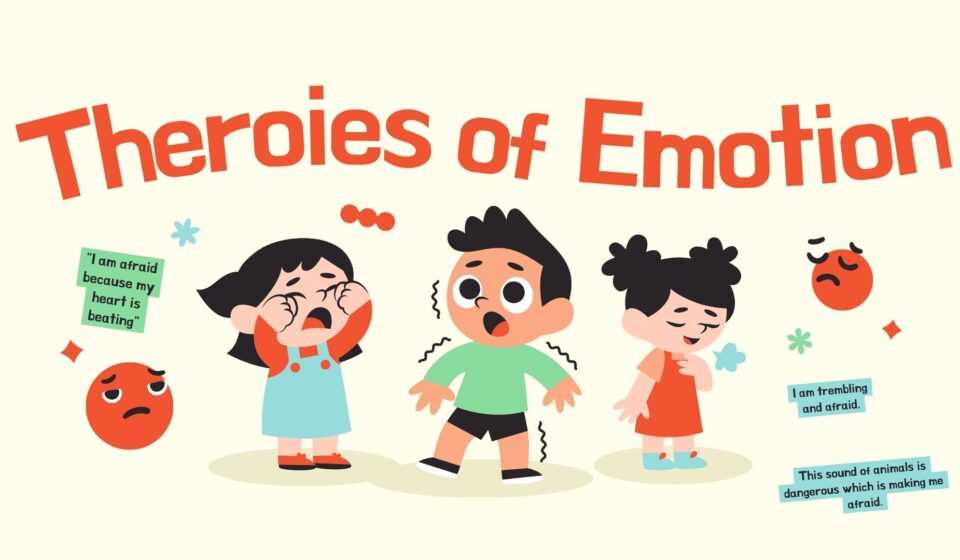
“I am afraid because my heart is beating”
Cannon-Bard theory
The Cannon-Bard theories of emotion was developed by physiologists Walter Cannon and Philip Bard independently as well. The merge theories are collectively known as Cannon-Bard theory.
According to this theory, we feel the emotions and experience the physiological reactions such as sweating, trembling and muscle tension simultaneously. For example lets imagine we are into a Jungle Walk, and suddenly we hear the sound of animals. Our heart rate increases tremble and fear at the same time.
I am trembling and afraid.
Schachter-Singer theory
The Schachter-Singer theories of emotion was collectively developed by Stanley Schachter and Jerome E. Singer.
The Schachter-Singer theory differs from above mentioned theories. They suggest that when an event causes physiological arousal, we try to find a reason for this arousal. Then we experience and label the emotion. For example, let’s imagine we are in Jungle Walk, suddenly we hear the sound of animals. Our brain interprets the noise and analyzes the Tiger and then we fear. This theory suggests that we may experience similar emotions on different occasions and our brains analyze and interpret.
This sound of animals is dangerous which is making me afraid.
Key Criticism
| Theory | Main Idea | Key Criticism |
| James-Lange Theory | We experience physiological changes first and the perception of these changes produces emotion. | Similar physiological responses can occur across different emotions, so bodily changes alone may not explain the full emotional experience. |
| Cannon-Bard theory | An emotional stimulus procduces physiological arousal and conscious emotional experience at the same time. | It doesn’t fully explain how different emotions are differentiated or the role of cognitive interpretation. |
| Schachter-Singer theory | Emotional results from physiological arousal + congnitive interpretation of that arousal. | Cognitive labeling doesn’t always appear necessary for emotion, and later research suggest emotions can occur rapidly without conscious interpretation. |
In summary, modern psychology genrerally views that emotion as a multidimensional process rather that something that can be explained by a single theory. Biological process, physiological arousal, cognitive appraisal, behaviour and social cultural context interact to produce emotional experiences.
