







Schizophrenia: Symptoms, Causes, Types, and Treatment
Table of Contents
Clinical Picture
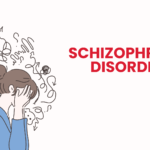
Schizophrenia is a major psychotic disorder that affects personal thinking, emotion, and behaviors. It’s a combination of disorders, which inevitably has a devastating effect on the lives of people, their family and friends. Individuals with this disorder lose touch with reality, misinterpret the sensory information (often hear voices, see things) and express odd behavior that other people don’t sense.
An early history of schizophrenia can be traced back in 1809 when Jhon Haslam superintendent of Britain hospital in his report outlined some symptoms of schizophrenia (he used the term “a form of insanity”). Philippe Pinel in 1801/1809 also described cases of schizophrenia in his hospital. After another 50 year in 1852 Benedict Morel used the term dementia praecox. A German psychiatrist Emil Kareplin in 1899 used the term dementia praecox to describe cluster symptoms of psychosis. However the term schizophrenia was introduced into the medical language in 1908 by the Swiss psychiatrist Bleuler meaning “splitting of the mind”.
Schizophrenia is a complex, chronic mental health disorder and affects all the functions individuals rely upon each day (social interaction and everyday activities). It’s a combination of symptoms including delusions, hallucinations, disorganized speech or behavior, and impaired cognitive ability (Patel, Cherian, Gohil & Atkinson, 2014). These symptoms can be described as positive, negative and cognitive symptoms.
Positive symptoms
Also known as psychotic symptoms it’s obvious signs of psychosis and they are i.e. qdelusion and hallucination. Positive symptoms include misperceptions, distorted thinking, and disorganized behaviors. This type of symptom is not normally seen in general people. Individuals diagnosed with schizophrenia must display at least one or two positive symptoms. These kinds of signs are absolutely considered abnormal by the social culture.
Delusion
Delusion in simple terms is the misinterpretation of realities. Its false beliefs that are held by individuals despite there is no strong evidence of it. For instance, a person affiliated to a political party’s candidate for prime minister election. He would be very suspicious towards journalists; he believed them as the agents of his rival party. He misinterprets and believes that they are there to get all his thoughts from brain and are plotting for his defeat.
Delusion can be of several forms, in an above example this is delusion of grandeur and persecutor. In the same case, if the person believes that there is a chip being hidden in his body, for monitoring his activities by his rival, this certain delusion is known as somatic delusion.
Hallucination
Hallucination on the other hand is the misinterpretation of sensory information. It’s a false perception such as hearing voices or seeing things that aren’t actually there. Hallucination can involve any of the sense organs. However auditory information is commonly experienced by the people with schizophrenia. Visual hallucination is seeing things, olfactory hallucination is smelling things, gustatory hallucination is tasting things and tactile hallucination is feeling things that are not there or that other people haven’t sense. It’s common to have some episode of hallucination. For example you may hear someone calling your name, and later discover that there was no one calling your name.
Negative symptoms
In contrast to positive symptoms, negative symptoms indicate absent or insufficiency signs in individuals with schizophrenia. It’s not necessary for individuals to have negative symptoms. Negative symptoms refer to difficulty functioning normally and socially withdrawing. Negative symptoms are also known as 4A’s.
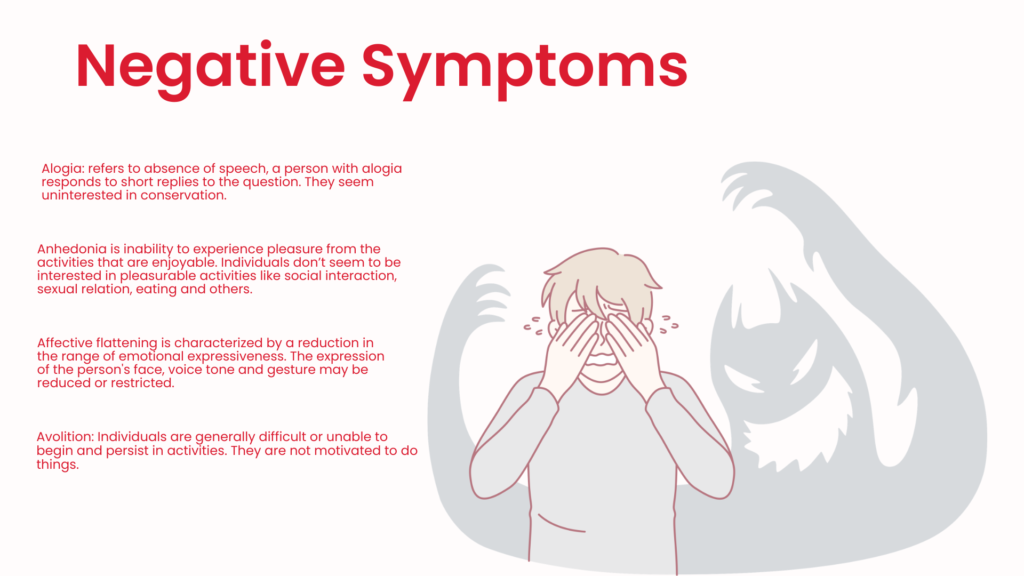
Avolition
Individuals are generally difficult or unable to begin and persist in activities. They are not motivated to do things.
Alogia
Alogia refers to absence of speech, a person with alogia responds to short replies to the question. They seem uninterested in conservation.
Anhedonia
Anhedonia is inability to experience pleasure from the activities that are enjoyable. Individuals don’t seem to be interested in pleasurable activities like social interaction, sexual relation, eating and others.
Affective flattening
Affective flattening is characterized by a reduction in the range of emotional expressiveness. The expression of the person’s face, voice tone and gesture may be reduced or restricted.
Diagnostic Criteria (DSM)
A. Two (or more) of the following, each present for a significant portion of time during a 1 -month period (or less if successfully treated). At least one of these must be (1 ), (2), or (3):
- Delusions.
- Hallucinations.
- Disorganized speech (e.g., frequent derailment or incoherence).
- Grossly disorganized or catatonic behavior.
- Negative symptoms
B. For a significant portion of the time since the onset of the disturbance, level of functioning in one or more major areas, such as work, interpersonal relations, or self-care, is markedly below the level achieved prior to the onset (or when the onset is in childhood or adolescence, there is failure to achieve expected level of interpersonal, academic, or occupational functioning).
C. Continuous signs of the disturbance persist for at least 6 months.
D. The disturbance is not attributable to the physiological effects of a substance (e.g., a drug of abuse, a medication) or another medical condition.
Comorbidity
Substance related disorder and depression is frequently relevant with schizophrenia (WHO, 1998) in extreme rates, DSM-5 has mentioned that over half of individuals consume tobacco use disorder and smoke cigarettes regularly. There are also high chances that individuals with schizophrenia will develop obsessive-compulsive disorder and panic disorder. Beside mental health comorbidity, schizophrenia individuals may also have other medical conditions like weight gain, diabetes, cardiovascular which makes their life expectancy less.
Epidemiology
Schizophrenia is a rare disorder, life time expectancy of schizophrenia rate to men and women is 0.2 % to 1.5% in the general population worldwide (Jablensky, 2012). 1% of the general population worldwide is affected by schizophrenia. The prevalence rates of schizophrenia may be slightly high, as many people across the world may go undiagnosed and untreated for their lives. Typical age of onset is different among men and women, for men it’s 18 to 25 and for women it’s 25-35 (Zeeshan, Rassol, Zafar, Ali & Erum, 2018). About 1 in 10,000 people are affected by schizophrenia (Hafner, 1997).
Etiology
The cause of schizophrenia is uncertain; nature versus nurture is debated over time. The most established theory is the stress vulnerability model. This model proposes that schizophrenia is caused by combination of three types of factor (Nuechterlein, Dawson, et.al, 1994)
Biological explanation believes its role of heredity, brain and neurotransmitter that cause schizophrenia. Schizophrenia runs in families, it can affect multiple members within families, schizophrenia occurs in about 10% of people who have a first degree relative (parents and sibling) with disorder, it also runs in second degree relative to 3% (McDonald & Murphy, 2003). The identical twin has 40 to 60 percent chance of developing this disorder (Mental health research, education and clinical center, n.d). If both parents have schizophrenia risk is about 40% of children to produce schizophrenia (McDonald & Murphy, 2003).
The most widely contemplated neurotransmitter hypothesis of schizophrenia is dopamine; excess flow of dopamine results in the positive symptoms (Grunder & Cumming, 2016). Another neurotransmitter involved is glutamate (Clinton & Meador, 2004) and serotonin dysfunction will result in psychosis. Brain abnormalities especially in the area of ventricle, frontal lobes are associated with Schizophrenia (Barlow, 2015).
Not just biological triggers of schizophrenia, some others believe that environmental factors or stressor (Fox, 1990) also play a key role for those who are vulnerable to this disorder. Individual social class structure (low socioeconomic status, poor housing, social isolation, loss of cultural identity and discrimination), poverty malnutrition and smoking (during pregnancy) obstetric complication (Takei & Mortensen, 1966), substance uses (cannabis) are indentified as big risk factors for schizophrenia.
Similarly physiological factors such as living or working in stressful circumstances (hazardous job setting, war affected zone), family and relationship conflict, physical including sexual or mental abuse, death of loved one are also associated with the illness (Mental health research, education and clinical center, n.d).
Treatment
Individuals with schizophrenia require a lengthy course of treatment, which happens to be in and outpatient treatment; which is determined by psychologist and psychiatrist. Blend of both psychologist and psychiatric based support in most. Since its lifelong condition, effective treatment can help a person manage the symptoms.
Psychosocial treatments help patients deal with everyday challenges of schizophrenia in three different categories, individual, group and cognitive behavior. These treatments are often most helpful after patients find a medication that works. Cognitive behavioral therapy, behavioral skills training significantly help to address the negative and cognitive symptoms. Most individuals benefited by the integration of these therapies with medication. It helps individuals to improve coping skills to address everyday challenges. In CBT specific symptoms are identified as problematic by the patient and/or therapist and become targeted for special attention in cognitive behavior therapy.
Group therapy includes a group of 6-8 individuals with a similar problem, they are then psycho-educated about the problem, helping them to acquire social skills training. They are also provided with group counseling, and group psychotherapy, with some groups providing a blend of these modalities. The goals of this type of group therapy is to enhance them to develop problem solving, goal planning, social interactions, and medication and side effect management (Simpson & May, 1980).
Social skill training (SST) helps schizophrenia patients acquire behavioral techniques or skills to meet their interpersonal, self-care, and coping demands of community life (Mueser, DeRisis & Liberman, 1989). The goal of social skills training is to help individuals to improve their daily functioning. Role playing, positive and corrective feedback, and assignments are some techniques of SST.
Assertive community treatment (ACT) is effective for individuals with the greatest services needs, such as those with a history of multiple hospitalizations. In ACT treatment is received from 10-12 professionals including case managers, psychiatric, nurse social work. They provide support 24 hour 7 days. They provide supportive therapy, case management, rehabilitation services, peer support and others.
It’s also essential to integrate family members in the treatment process as it offers them to be acknowledged with schizophrenia and strategies for supporting the schizophrenic individuals. Both short term (few sessions) and long term (6-9 months) family therapy/psychoeducational/family intervention can help in the prevention of relapse and hospitalization (Dixon, Johnson & Duncan, 2009).
