











Bipolar and Related Disorder
Bipolar and Related disorder was formerly known as manic depression, it is a lifelong mental health condition that disrupts social, occupational and personal day to day activities which include Manic and Hypomanic episode.
Table of Contents
Introduction
Bipolar and related disorder are a group of mood diagnoses that is mentioned in the Diagnostic and Statistical Manual of Mental Disorders (DSM 5 TR) characterized by significant disturbance in the person’s mood, energy,activity level and behaviour which include both Manic and Hypomanic episode. Mood is hypothesized to be the main underlying feature. This involves episodes of Manic and Hypomanic often alternating with depressive episodes. There are two groups of disorder which are broadly recognized those divisions is based on whether a Manic and Hypomanic episode has ever been present.
Mania
Mania or Manic is a distinct period of abnormally and persistently elevated, expansive or irritable mood which increased energy and acitivity of the indiviudals for at least 1 week (might even be hospitalized). For example a person may sleep only 2-3 hours for several days, talk continnuously, spend excessive money and believe they have extraordinary abilities.
Diagnostic Criterion (Manic Episode)
A. Manic Episode requires a distinct period of abnormally and persistently elevated, expansive, or irritable mood and increased goal-directed activity or energy, lasting at least 1 week (or any duration if hospitalization is necessary)
B. The period must include three (or more) of the following symptoms (four if the mood is only irritable)
- Inflated self-esteem or grandiosity.
- Decreased need for sleep (e.g., feeling rested after only 3 hours).
- More talkative than usual or pressure to keep talking.
- Flight of ideas or subjective experience that thoughts are racing.
- Distractibility (attention too easily drawn to unimportant stimuli).
- Increase in goal-directed activity or psychomotor agitation.
- Excessive involvement in activities that have a high potential for painful consequences (e.g., unrestrained buying sprees, sexual indiscretions).
C. The mood disturbance must be sufficiently severe to cause marked impairment in social or occupational functioning or necessitate hospitalization
- Hypomanic Episodes are similar but are less severe and last at least 4 consecutive days, and they are not severe enough to cause marked impairment or require hospitalization
- Mixed State: A combination where the person experiences symptoms of both mania and depression (e.g., agitation and suicidal thoughts) at the same time
- Rapid Cycling: Characterized by four or more severe mood disturbances within a single year (American Psychiatric Association, 2013)
Hypomanic
Hypomanic or hypomania is less severe form of mania. The symptoms are similar but they last at least 4 consecutive days and are not severe enough to cause marked impairment, require hospitalization or involve psychosis. For example a person may become unusally energetic,talkative, productive and sociable when needing very little sleep, but can generally continue their daily responsibilities.
Diagnostic Criterion (Hypomanic Episode)
A. A distinct period of abnormally and persistently elevated, expansive, or irritable mood and abnormally and persistently increased activity or energy, lasting at least 4 consecutive days and present most of the day, nearly every day.
B. During the period of mood disturbance and increased energy and activity, three (or more) of the following symptoms (four if the mood is only irritable) have persisted, represent a noticeable change from usual behavior, and have been present to a significant degree:
- Inflated self-esteem or grandiosity.
- Decreased need for sleep (e.g., feels rested after only 3 hours of sleep).
- More talkative than usual or pressure to keep talking.
- Flight of ideas or subjective experience that thoughts are racing.
- Distractibility (i.e., attention too easily drawn to unimportant or irrelevant external stimuli), as reported or observed.
- Increase in goal-directed activity (either socially, at work or school, or sexually) or psychomotor agitation.
- Excessive involvement in activities that have a high potential for painful consequences (e.g., engaging in unrestrained buying sprees, sexual indiscretions, or foolish business investments).
C. The episode is associated with an unequivocal change in functioning that is uncharacteristic of the individual when not symptomatic.
D. The disturbance in mood and the change in functioning are observable by others.
E. The episode is not severe enough to cause marked impairment in social or occupational functioning or to necessitate hospitalization. If there are psychotic features, the episode is, by definition, manic.
F. The episode is not attributable to the physiological effects of a substance (e.g., a drug of abuse, a medication, or other treatment).
Depression
Depression is low, a sad state is marked by feelings of worthlessness, guilt, sadness, emptiness, or hopelessness. Key symptoms include anhedonia (inability to experience pleasure), changes in appetite or sleep (insomnia or hypersomnia), fatigue, and cognitive problems like difficulty concentrating.
Types
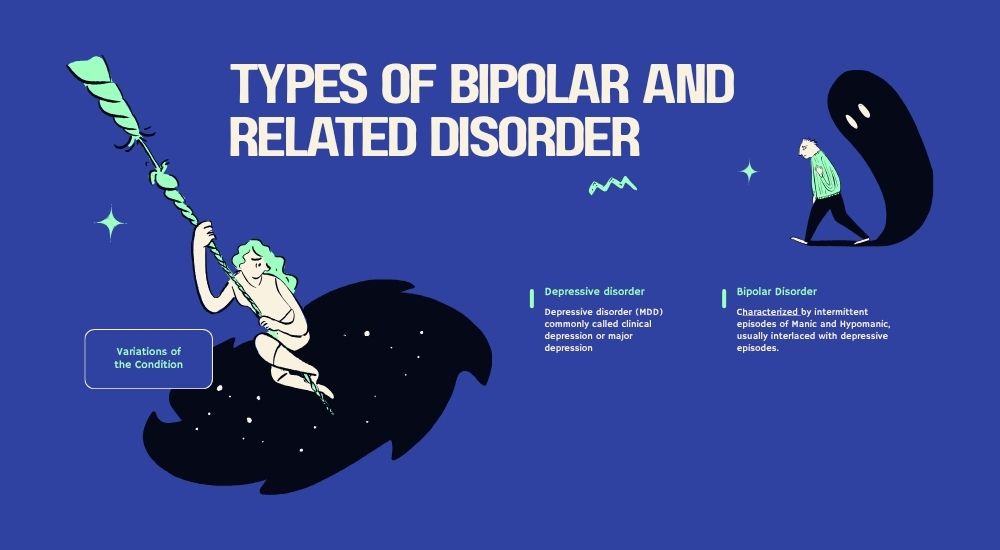
1. Depressive disorder (MDD) commonly called clinical depression or major depression,
2. Bipolar disorder, formerly known as manic depression and characterized by intermittent episodes of Manic and Hypomanic, usually interlaced with depressive episodes.
