














Specific Learning Disorder
Table of Contents
Clinical Picture
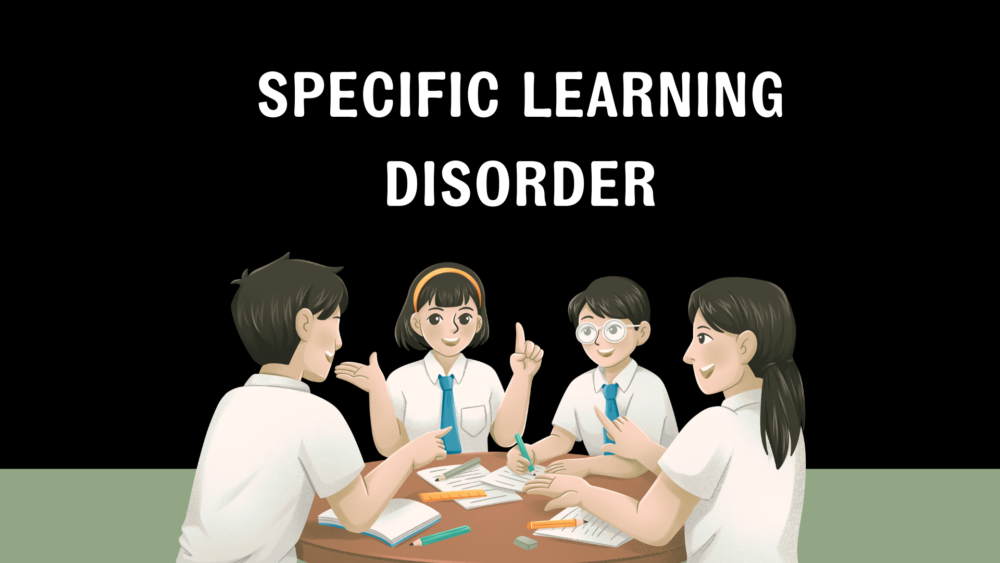
Specific Learning Disorder (also referred to as learning disorder or learning disability) is a neurodevelopmental disorder that has ongoing problems in one of three areas, reading (dyslexia), writing (disgraphia) and math (dyscalculia), which are foundation to one’s ability to learn. This type of problem begins during school-age, although may not be recognized until adulthood. In DSM IV TR learning disorders were specified into reading, writing and mathematics but DSM 5 have overlapping them and are considered as single disorders.
Though started in school, it can be continued to adulthood or even in whole life. But most of the learning problem happens to be treated as individuals grow with age. Individual in learning disorder have problem in three core elements of learning they are
Dyslexia refers to the difficulty with reading. Individuals with dyslexia have significantly difficulty in connecting letters which result in slow fluent reading. They have problems in identifying alphabets for example d with b, u with v.
Dysgraphia refers to the difficulties putting one’s thoughts either verbally or in verbally (paper). Not just with expression, they have problems spelling, grammar, punctuation and handwriting.
Dyscalculia refers to the difficulties learning concepts of mathematics such as numbers symbols and functions to perform math calculations like additional, subtraction, division, and multiplication. Not limited to only this they have problems with algebraic and others.
Specific Learning Disorder if not recognized and managed early in childhood can cause significant problems throughout a person’s life beyond having lower academic achievement. These problems include increased risk of greater psychological distress, poorer overall mental health, unemployment/under-employment and dropping out of school.
Diagnostic criteria for Specific Learning Disorder
- Have difficulties in at least one of the following areas for at least six months despite targeted help:
- Difficulty reading (e.g., inaccurate, slow and only with much effort)
- Difficulty understanding the meaning of what is read
- Difficulty with spelling
- Difficulty with written expression (e.g., problems with grammar, punctuation or organization)
- Difficulty understanding number concepts, number facts or calculation
- Difficulty with mathematical reasoning (e.g., applying math concepts or solving math problems)
- Have academic skills that are substantially below what is expected for the child’s age and cause problems in school, work or everyday activities.
- The difficulties start during school-age even if some people don’t experience significant problems until adulthood (when academic, work and day-to-day demands are greater).
- Learning difficulties are not due to other conditions, such as intellectual disability, vision or hearing problems, a neurological condition (e.g., pediatric stroke), adverse conditions such as economic or environmental disadvantage, lack of instruction, or difficulties speaking/understanding the language.
Comorbidity
According to APA, 2013 Specific Learning Disorder commonly co-occurs with other disorder especially with neurodevelopmental disorder i.e. ADHD, communication disorders, autistic spectrum disorder or other mental disorders i.e. anxiety disorders, depressive and bipolar disorders. Whereas some research also has found that Specific Learning Disorder co-occurs with language disorder, depressive disorder, oppositional defiant disorder and tic disorder (Cherif Ayedi et.al. 2018).
Prevalence
The prevalence rate of specific learning disorder across the academic domains of reading, writing, and mathematics is 5%-15% (APA, 2013) among school-age children across different languages and cultures. Prevalence in adults is unknown but appears to be approximately 4% (APA, 2013). Learning disorders are among the most frequently diagnosed developmental disorders in childhood. Epidemiological studies report comparable prevalence rates of 4–9% for deficits in reading and 3–7% for deficits in mathematics (APA, 2013).

Etiology
Actual causes of Specific Learning Disorder are yet to be discovered, despite various causes for learning disabilities have been proposed. Many researchers have categorized the etiological factors for learning disabilities into three groups: biological and genetic, and environmental.
Biological and genetic
Specific Learning Disorder run in family, families and twins studies have enough evidence to prove of genetic link As per twin study if a twin has learning disability another twin is also likely to develop the disorder i.e 68 percent in monozygotic and 40 percent in dizygotic. 35 to 45 percent of the first degree relatives of persons with reading disabilities also have reading disabilities (Pennington, 1990). A possible linkage to genes on chromosomes 6 and 15 has also been identified in causing Specific Learning Disorder (Pennington, 1990).
Specific Learning Disorder can be also caused due to structural damage or improper function of the nervous system. This can happen in any stages of prenatal or postnatal stages of pregnancy. Right (dyscalculia) and left (reading) hemisphere damage in children may take place (Rao, 2003). Alternative to this head injury, complications during birth resulting in a lack of oxygen to the brain can also cause LD.
Environmental Factors
Pregnancy is a critical phase for both mother and infancy, if not taken greater care lifelong problems can be sourced. Malnutrition or exposure to lead in water or in paint, excessive emotional disturbance, poor prenatal or postnatal health care, use of substances abuse like alcohol or drugs (for example foetal alcohol syndrome), premature birth, illness during pregnancy all contribute to the learning disabilities. In some case learning difficulties can also be caused by brain injury which can be caused by road accident or even a child abuse.
Treatment
Half of the children with learning difficulties are not diagnosed with Specific Learning Disorder and never seek any sort of treatment. Being developmental problems, these difficulties may resolve as the children grow younger. But in many cases problems may get worse and require professional help. Learning disabilities children primarily require an education intervention program. If diagnosed or screed earlier, the problem can be reduced or controlled. One of the important actors for Specific Learning Disorder are teachers or learning specialists rather than psychologists or psychiatrists. They help the children with special teachings and learning methods and help in building strengths for their weaknesses. Children are taught in the least restrictive environment appropriate for them.
In addition to specialized education intervention programs, they may also get help from speech therapists if required. Another important point to be noted is if the children diagnosed with comorbid ADHD are restricted for biological drugs. Uses of drugs are not effective in treating SLD.
